
Perennial Grains – An Agricultural Revolution
Perennial grains such as Kernza and bulbous barley can play an important role in the transition to more sustainable agriculture. With deeper root systems and less need for tillage, they have the potential to improve soil health, increase resilience, and reduce climate impacts. But bringing new grain crops into practical use requires continued plant breeding, advances in cultivation, and collaboration. Axfoundation is therefore working with researchers to develop and adapt perennial grains for northern European conditions – from research and field trials to future food applications.

Perennial grains such as Kernza® can be harvested for several consecutive years without reseeding—a trait that can contribute to more sustainable farming systems. Photo: Axfoundation.
The Issue
Perennial grains have considerable potential to contribute to more sustainable and resilient agriculture, but they are still at an early stage of development. Unlike today’s grain crops, they have not yet undergone the long-term plant breeding needed to combine robust traits with high, stable yields.
For perennial grains to become an option in the agriculture of the future, traits such as kernel size, seed maturity, yield, and yield stability need to improve. We also need to understand how these crops perform in Nordic farming systems and how they can be used in food products and future value chains.
Perennial crops have the potential to fundamentally change how we grow grain – from a system in which the soil is tilled every year to one that builds soil fertility over time
– Maria Lundesjö, Project Manager, Future Food, Axfoundation
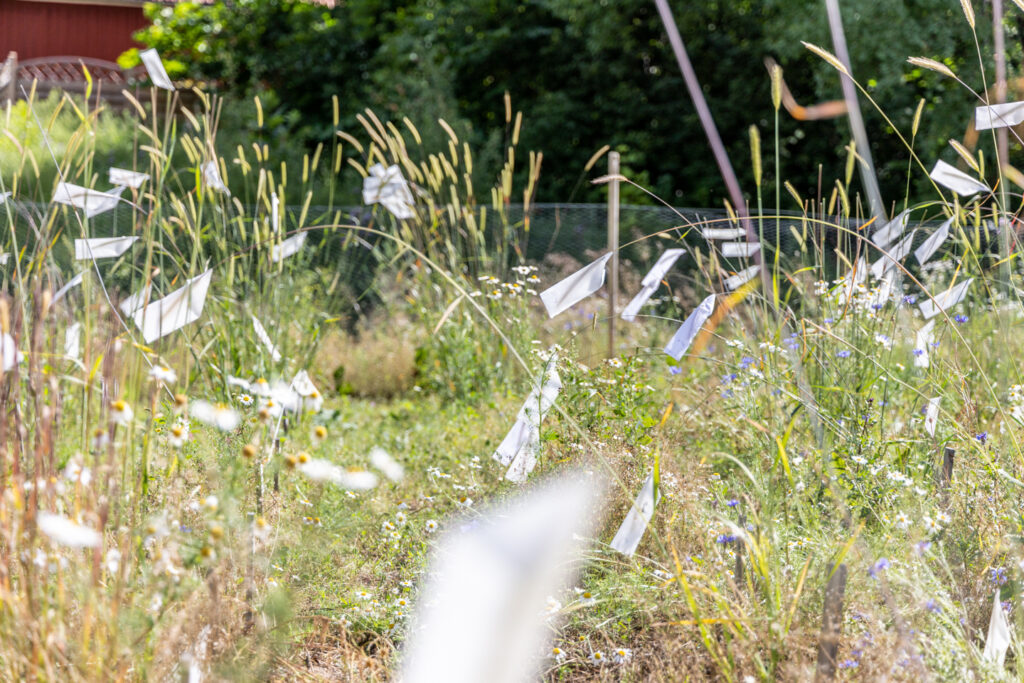
At Torsåker Farm, SLU is researching the domestication and breeding of bulbous barley—an important step toward developing the world’s first perennial barley crop. Photo: Axfoundation.
Our Solution
Developing perennial grains depends on long-term collaboration between research and practical farming. Together with researchers from the Swedish University of Agricultural Sciences (SLU), large populations of Kernza and bulbous barley are being developed and tested at Torsåker Farm to identify the plants with the greatest potential to become the grain crops of the future. Plant breeding, field trials, and repeated selection gradually improve traits such as yield, kernel size, seed quality, and maturity. At the same time, this work builds knowledge of how the crops perform in Nordic farming systems and how they can be used in future food products.

With deeper, longer-lived root systems, perennial crops such as Kernza can improve soil health. Photo: Axfoundation.
Perennial Grains
Perennial grains are crops that grow and can be harvested for several years without reseeding. Their deep root systems sequester carbon in the soil, improve soil structure, and make plants more resilient to drought and extreme weather. They also reduce the need for tillage, saving both energy and agricultural inputs.
Kernza – A Perennial Relative of Wheat
Kernza is the trademark name for grain from improved populations of Thinopyrum intermedium, a perennial relative of wheat. The plant regrows after harvest and can produce grain for several years without reseeding. Its deep, long-lived root system can contribute to better soil structure, more efficient nutrient uptake, and greater drought tolerance.
Domestication began at Rodale Institute and has since been advanced by The Land Institute in the United States. Since 2018, SLU has been testing and breeding the plant material at Torsåker Farm in collaboration with Axfoundation and international researchers, including researchers at The Land Institute. Key breeding goals include larger kernels, higher and more stable yields, and better adaptation to Nordic growing conditions.
Bulbous Barley – Perennial Barley
Bulbous barley (Hordeum bulbosum) is a wild perennial relative of common barley. The species has considerable genetic diversity and is adapted to a wide range of environments, making it particularly interesting for the development of perennial barley for cold climates.
Researchers at SLU identified bulbous barley as a promising candidate after investigating several perennial relatives of barley. Since 2021, selected plants have been grown and bred at Torsåker Farm, with the aim of developing a crop suitable for cultivation that regrows after harvest. The research involves international collaboration with partners including the University of Copenhagen and the Carlsberg Research Laboratory. Key traits to improve include kernel size, yield, winter survival, and uniform seed maturity, as well as reduced seed shattering, the shedding of seeds before harvest.
Perennial Wheat – A Hybrid of Wheat and Perennial Wheatgrasses
Perennial wheat is being developed by crossing annual bread or durum wheat with perennial wheatgrasses, such as species in the genus Thinopyrum. Unlike Kernza, which is developed by directly domesticating a wild perennial species, this approach uses hybridization to combine wheat’s large kernels and food quality with the regrowth capacity and long-lived root systems of its perennial relatives.
The Land Institute launched its perennial wheat breeding program in 2001 and developed its first perennial hybrid line in 2009. Promising lines are now being tested in different countries and growing environments, including at Torsåker Farm. Key breeding goals include reliable regrowth and winter survival, high and stable grain yields, and good food quality. The crop may also have potential for use as both grain and forage.
Perennial Rye – A Perennial Rye Hybrid
Perennial rye is being developed by crossing cultivated rye (Secale cereale) with the wild perennial rye Secale strictum, also known as Secale montanum. The aim is to combine cultivated rye’s cold tolerance and kernel traits with its wild relative’s ability to regrow after harvest. Because rye is already well adapted to colder climates, the crop is of interest for Nordic farming systems.
Perennial rye is still at the research and development stage. Plant material will be tested at Torsåker Farm to learn more about its traits and potential for development under Nordic conditions.
Our Work
Axfoundation is working with the Swedish University of Agricultural Sciences (SLU) to advance the development of perennial grains. Torsåker Farm provides the conditions for long-term field trials in which new grain crops can be developed and evaluated under practical farming conditions.
Axfoundation’s role also includes developing food applications for perennial grains, building collaboration among researchers, farmers, and food companies, and helping establish the conditions needed to bring perennial grains into practical use over time.
Project Goals
The project aims to develop perennial grains for northern European conditions through plant breeding, practical field trials, and the development of future food applications. The goal is to build the knowledge and establish the conditions needed for perennial grains to become part of the agriculture of the future.

In 2026, perennial rye was sown at Torsåker Farm for future field trials.

Pizza made with Kernza flour has been served at Torsåker Farm.

Bread made with Kernza flour.

In fall 2021, one of Torsåker Farm’s 0.5-hectare trial plots was harvested for the first time with a conventional combine harvester, demonstrating that Kernza can be harvested with machinery used in conventional agriculture. Photo: Douglas J. Cattani.
Are You a Farmer Interested in Perennial Grains?
Interest in perennial grains is strong, but the crops are still under development and no commercial seed is yet available in Sweden. Axfoundation is therefore collecting expressions of interest from farmers who would like to follow developments, share their experience, and potentially take part in future growing trials once the necessary conditions are in place.
Registering your interest does not constitute a seed order. It helps us gauge interest, connect with farmers, and better understand which growing environments and conditions are relevant for future trials.
Results
Work on perennial grains has made several important advances. At Torsåker Farm, Kernza has been harvested using conventional farming techniques for several years, demonstrating that the crop can be grown and harvested with existing farm machinery. Initial food trials also show promising quality and flavor.
At the same time, the project has expanded from individual field trials into a broader collaboration. Kernza is now grown on several Swedish farms, plant material from several European growing sites is being analyzed to support an updated Novel Food authorization process, and the research covers an increasing share of the value chain – from cultivation and processing technologies to products and future markets.
Research on perennial barley has also made important advances. An SLU study evaluated 151 lines derived from crosses between common barley and its perennial relative, bulbous barley. Several lines showed a strong ability to regrow after harvest, and researchers have identified promising genetic material for further breeding. The results also show that winter survival is an important trait to improve for perennial barley to perform well in a Nordic climate.
Research on Kernza shows clear progress. A review of research on intermediate wheatgrass breeding found that grain yield increased by approximately 9 percent per breeding cycle over eight breeding cycles. More recent studies also show how cultivation practices can be improved to maintain the crop’s productivity over several years. Adjusting nitrogen fertilization and managing older stands can help sustain grain yields, while fall grazing after harvest did not reduce the following year’s grain yield. These findings strengthen Kernza’s potential as both a grain and forage crop.
Partners
Research and breeding on Kernza are conducted by the Swedish University of Agricultural Sciences (SLU) in close collaboration with The Land Institute in the United States. At Torsåker Farm, Axfoundation and SLU collaborate on field trials and the development of the crop for Nordic conditions.
Research on bulbous barley is conducted by SLU in collaboration with the University of Copenhagen and the Carlsberg Research Laboratory in Denmark.
Axfoundation and LUCSUS (Lund University Centre for Sustainability Studies) collaborate on trials of perennial grains on farmers’ land. Through a network of trial farms, we gather and exchange practical experience of crop establishment, cultivation, and harvesting under different conditions. This work helps us understand what is needed to grow these crops on a larger scale in the future.
In 2022–2023, Wasabröd co-funded SLU’s research on genomic selection in Kernza, with the aim of accelerating plant breeding for Nordic conditions.
Contact

Projects within Future Food




Updates on Future Food
-

Could Hemp Seeds be the Future of Food?
2026-03-30
-

A Planetary Menu for Everyday Swedish Meals
2025-10-22
-

Can PFAS Save the Baltic Sea?
2025-04-22
-

More of the Plant Should Become Food
2025-02-24


