
RE:source – Chemical Recycling of Polyester
How can the recyclability of plastics increase? Particularly contaminated plastics today considered worthless from a recycling perspective? These were the challenges addressed within the RE:source funded project “Chemically recycled PET/polyester as raw material for additive and new polymer” running from 2018 to 2020. The project was led by RISE (Research Institutes of Sweden), and Axfoundation, Axel Johnson International, and Axfood were part of the project team exploring the recycling potential of a residual flow of plastic waste. Successful testing within the project showed that contaminated plastics, such as worn out industrial straps and colored laminate packaging, can be chemically recycled into pure monomer. Thereby, the project showed that there is a future market potential for waste streams of contaminated polyester products.
The Issue
The use of polyethylene terephthalate (PET) polyester has increased tremendously in recent decades. In terms of volume, it is today the fourth most widely used plastic in the world. Its popularity resides in its mechanical properties, machinability and low price, which makes PET suitable for everything from textile fibers and bottles to film. There are, however, also downsides to using PET. Although PET bottles are widely recycled (84% in Sweden), today there is no system for the large-scale recycling of textile fibers and other uses of PET. Instead, most of the plastic is burnt, at best for energy recovery. This not only means a loss of material but often also contributes to environmental issues. A major obstacle to increasing recycling is that all too often the plastic is contaminated, containing staining pigments, emollients, flame retardants, chemicals, labels, adhesives, or laminates, which makes the plastic difficult or impossible to recycle.
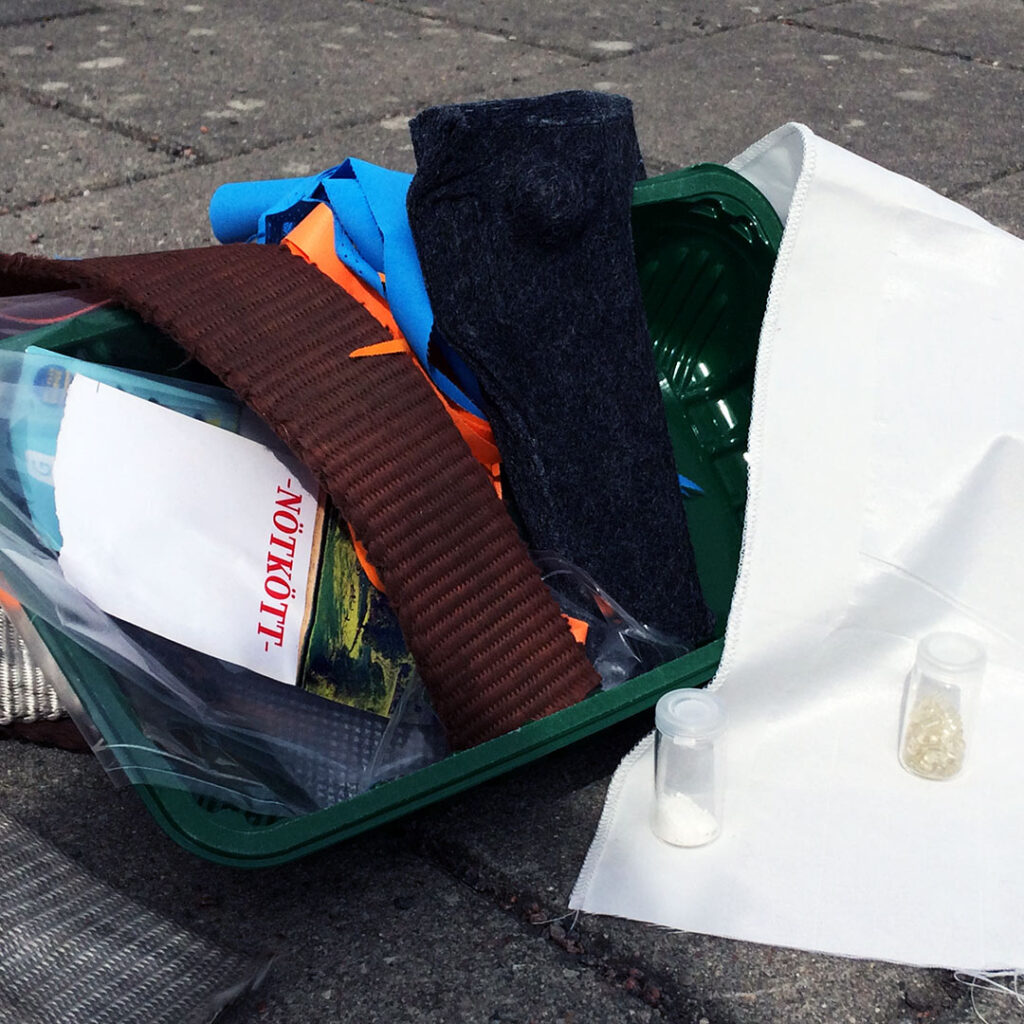
Contaminated plastics, such as worn out industrial straps and colored laminate packaging, can be chemically recycled into pure monomer.
Our Solution
The project gathered a wide range of partners aiming to explore and further develop a chemical process for increased material recycling of plastics. A chemical recycling process can handle contaminated plastic materials and the technology therefore has a role to play in a circular economy, when other recycling or reuse is not possible. Both research in the field and development in the market for chemically recycled plastics are progressing rapidly. Internationally, several chemical recycling initiatives using depolymerization are underway, yet many of them handle only specific, usually very pure streams of waste, such as PET bottles. This project instead tested a process that could handle several streams of real waste as well as contaminated materials used in industry.
Our Work
The project ”Chemically recycled PET/polyester as raw material for additive and new polymer” was led by RISE (Research Institutes of Sweden), financed by the research program RE:source. Thanks to a broad consortium set up, a wide range of partners from different industries and parts of the value chain were able to contribute materials, requirements, knowledge, processes, and testing to drive the project. The role of Axfoundation was to bridge research and business and contribute to concrete challenges that companies face.
Results
Successful testing showed that contaminated plastics, such as worn out industrial straps and colored laminate packaging, can be chemically recycled into pure monomer. The pure monomer produced can in turn be re-polymerized into virgin quality polyester for things like new textiles. By complementing the depolymerization recycling process with additional methods for removing pollution, the project showed the future market potential.
As part of this project, we took plastic streams that are considered useless, due to various impurities, and we proved that they can be upcycled. There is future market potential for waste streams of contaminated polyester products from industry, production waste, food packaging with laminates and labels, textile waste with difficult staining.
– Hanna Skoog, Programme Director, Future Materials, Axfoundation
According to Karin Lindqvist, project manager at RISE, an important success of the project was that whole packaging, including cover film, glue, labels and paint, was proven to be recyclable.
Different methods were used to remove contaminants such as color from plastic waste. We successfully enhanced the existing process with decolorization by extraction, activated carbon or filtration. In the end, we produced pure monomer.
– Karin Lindqvist, Project Manager, RISE
From testing to industrial scale
There was a strong interest among the project partners to push the development further as testing offered potential solutions to two practical problems: how to loop today’s worthless plastics, and how to ease the demand for virgin raw materials. Further development of the process is needed, as well as testing on a larger scale. The next step will include mapping waste streams of polyester in Sweden to evaluate the need for an industrial-scale depolymerization plant, the level of purity required, and assessing the need for pre-treatment, necessary logistics and costs.
The successful tests opened up new opportunities, and we hope to take the results to the next stage through a demonstration project aimed at testing the solution on a larger industrial scale as part of our From Waste to Fashion initiative.
– Hanna Skoog, Programme Director, Future Materials, Axfoundation
The aim was to explore the possibilities in recycling a significant amount of end-of-life polyester straps and round-slings from Axel Johnson International’s operations, which can be recycled and used as a resource by, for example, Filippa K. This material is often dirty and oily, and is therefore well suited for handling contaminated materials.
Partners
The project was led by Karin Lindqvist at research institute RISE and the project partners were: Axel Johnson International, Axfoundation, Axfood, Diab Group, Didriksons, FOV Fabrics, Förpacknings- och Tidningsinsamlingen, National Högsäter/Sweden, Nexam Chemicals, Perstorp AB, Recyctec AB, Sporda Nonwoven, and Tarkett AB.


